
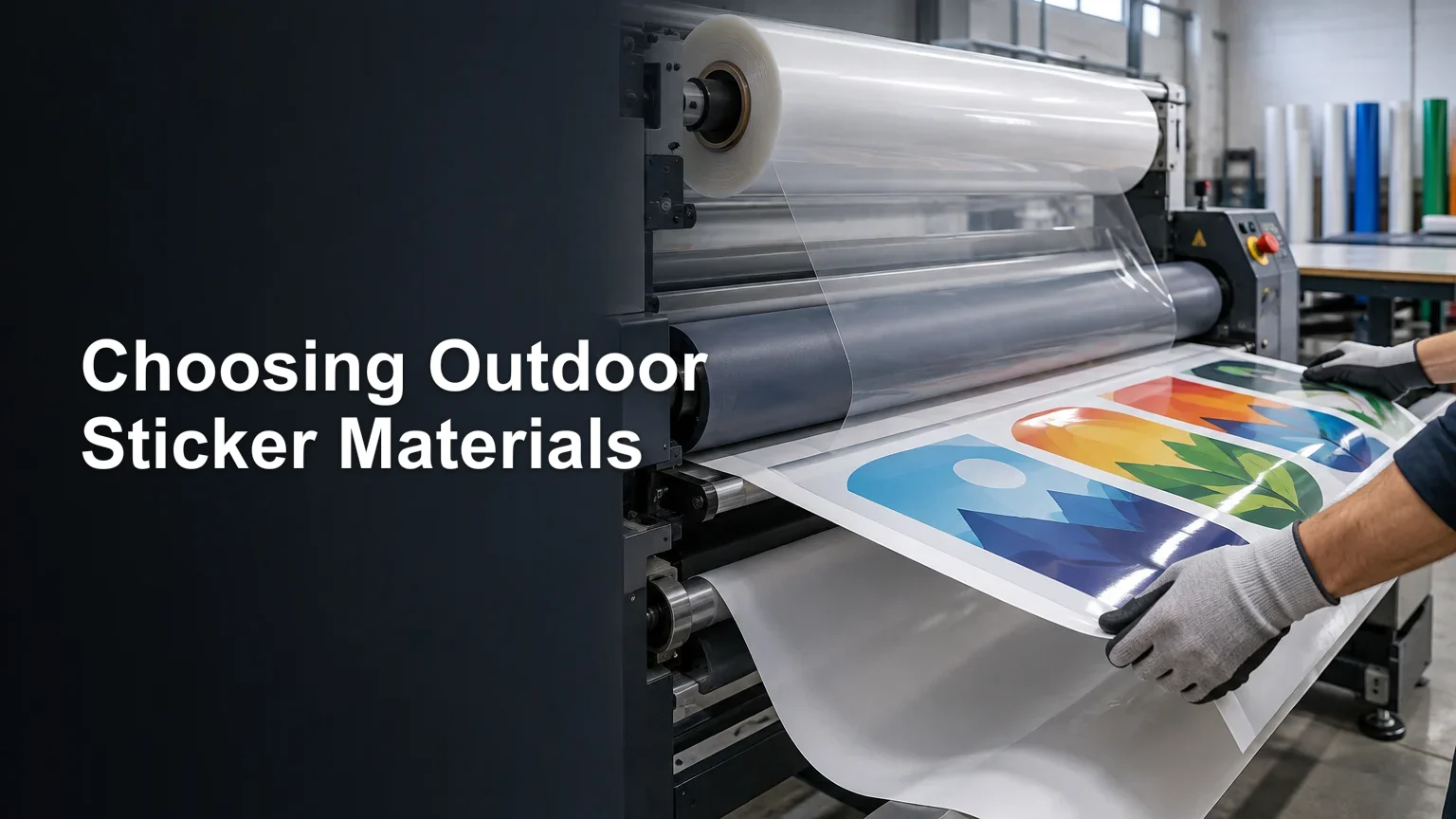
TLDR: The best sticker materials for outdoor use are usually vinyl films matched to the surface and exposure. Economical calendered vinyl suits short-term promotional decals and uncomplicated flat surfaces. Polymeric vinyl is the more dependable middle choice for longer-term signs and gentle curves. Cast vinyl is the appropriate direction for demanding vehicle graphics, compound curves, and other applications where conformability matters. In every case, the adhesive, ink, compatible laminate, surface preparation, and installation can matter as much as the face film.
The phrase “outdoor vinyl” is not a complete specification. It tells me roughly as much as “premium paper,” which is to say that it creates a pleasant mood while leaving the useful questions unanswered. When comparing the best sticker materials for outdoor use, start with what the decal must survive and where it will be applied—not with the material name printed on a vendor’s product page.
Start with the application, not the sticker catalog
Before requesting a quote, define the job in physical terms. A promotional decal placed vertically on a smooth shop window has a different life from a graphic wrapped over a vehicle recess. A bottle that is repeatedly handled and chilled presents different risks from a rigid sign mounted under an awning.
I would write down six requirements before discussing materials with a printer:
- Expected service period: weeks, months, or a genuinely long-term installation
- Exposure: direct sun, shade, rain, salt spray, cleaning, abrasion, and temperature changes
- Orientation: vertical, sloped, or close to horizontal
- Surface: glass, painted metal, plastic, powder coating, textured material, or another substrate
- Shape: flat, a simple cylinder, a gentle curve, or a compound curve with channels and recesses
- Removal requirement: permanent, cleanly removable, repositionable during installation, or replaceable without damaging the surface
These conditions determine the complete construction: face film, adhesive, ink system, protective layer, and installation method. If a quote says only “weatherproof vinyl,” ask for the missing information before treating it as comparable with another quote.
How to compare the best sticker materials for outdoor use
Most general outdoor decal decisions can be organized around three vinyl-film families: calendered, polymeric calendered, and cast. The labels describe how the film is made and, in practical terms, point toward differences in dimensional stability and conformability. They do not create a universal lifespan.
| Material direction | Best fit | Main advantage | Important limitation |
|---|---|---|---|
| Economical calendered vinyl | Short-term promotions and uncomplicated flat applications | Lower-cost construction for undemanding work | More vulnerable to shrinkage and lifting when used on demanding curves or beyond its intended exposure |
| Polymeric calendered vinyl | Medium-term signs, windows, panels, and some gentle curves | Better dimensional stability than basic promotional film | Not automatically suitable for deep channels or severe compound curves |
| Cast vinyl | Vehicle graphics, complex curves, long-term branding, and demanding conformability | Thin, conformable film designed for more difficult graphic applications | Higher material and installation cost can be unnecessary for a simple flat decal |
| Specialty adhesive film | Textured, low-surface-energy, powder-coated, or otherwise difficult substrates | Adhesive can be selected for a surface that defeats ordinary sticker stock | Requires surface-specific qualification rather than a generic “extra strong” claim |
Calendered vinyl for economical, uncomplicated work
Calendered vinyl is often the sensible choice for a short campaign, event decal, temporary directional sign, or another application on a clean, smooth, mostly flat surface. Paying for a vehicle-wrap film on a three-month window promotion may add cost without adding useful value.
The danger is allowing “vinyl” to become shorthand for “suitable everywhere.” An economical promotional film should not be stretched over deep channels or assumed to behave like a premium conformable product. On a simple flat application, however, a correctly specified calendered construction can be entirely appropriate.
Polymeric film for a stronger middle ground
Polymeric calendered film is often where I would begin for medium-term exterior signs, flat panels, windows, and limited curves when the buyer wants greater stability but does not need a full wrap system. ORAFOL positions ORAJET 3551 as a polymeric PVC film for applications including general signage and vehicle graphics, while its published durability conditions depend on the complete printed-and-laminated construction and use environment. ORAFOL’s ORAJET 3551 product information is a useful example of how a manufacturer defines a particular film rather than promising that every polymeric vinyl performs identically.
Cast film for curves and demanding graphics
Cast film becomes relevant when the surface shape is controlling the decision. Vehicle contours, rivets, recesses, channels, and compound curves place mechanical stress on the graphic. A film that looks perfectly respectable while flat on a release liner may try to return toward its original shape after installation.
3M identifies IJ180mC as a cast adhesive-backed print-wrap film intended for uses including outdoor signs, vehicle wraps, and external watercraft graphics. That positioning makes it evidence for a demanding application category, not proof that every cast product is interchangeable or that the film alone guarantees the finished graphic’s life.
For a full vehicle wrap or similarly difficult installation, I would specify a tested film-and-overlaminate system and use a graphics professional familiar with that system. Material selection and installer technique are connected here. Buying expensive cast vinyl and applying it badly is simply a premium version of the same problem.
Why outdoor stickers often need a laminate
A laminate is a clear protective film applied over the printed graphic. It can protect the printed surface from scratching, abrasion, moisture, and environmental exposure. Avery Dennison describes its DOL 3000 overlaminate series as providing scratch and abrasion resistance and resistance to UV exposure, temperature, humidity, and salt spray for applicable promotional graphics. Avery Dennison’s overlaminate information shows why laminate selection should be treated as part of a graphic system rather than an unnamed add-on.
Laminate is particularly valuable when the sticker will be handled, wiped, transported, or exposed to rubbing. Bottles, coolers, tool cases, equipment panels, and vehicle graphics can receive more mechanical abuse than a vertical sign that nobody touches.
What a laminate cannot do is equally important. It cannot correct an unsuitable adhesive, contaminated surface, unstable film, weak edge design, or poor installation. It also does not make every printed graphic chemically resistant. If cleaners, fuels, oils, solvents, or other chemicals are part of the environment, ask for resistance data relevant to the complete printed and laminated construction.
The face film and overlaminate should also be compatible. Combining components casually can create different shrinkage behavior or undermine the manufacturer’s stated performance conditions. I would ask the printer to identify both products and confirm whether the combination is a recommended system.
Match the construction to the outdoor use
Promotional decals and giveaways
For ordinary logo stickers, event giveaways, and short-term promotions, a general-purpose printed vinyl with an appropriate adhesive and protective finish is normally sufficient. The priorities are usually clean printing, usable adhesion, handling resistance, and reasonable cost—not extreme conformability.
For buyers who want to order custom outdoor stickers rather than engineer a specialty installation, CustomStickers.com states that its waterproof stickers use vinyl with a laminate coating, offers UV-resistant finish options, and assigns that product an outdoor-life claim of more than five years. Treat that as an attributed specification for its offering, subject to the actual application conditions, rather than a universal result for every sticker or surface. You can also review the broader distinctions among sticker materials and formats before settling on a product type.
Flat signs, panels, and windows
A calendered or polymeric film may work well when the substrate is smooth, stable, and mostly flat. The expected service period should drive how far up the material range you go. For a seasonal promotion, economical film may be the rational choice. For a branded panel expected to remain presentable through several seasons, I would place more weight on film stability, adhesive suitability, and a compatible laminate.
Bottles, coolers, and simple curved objects
A cylinder is less demanding than a compound vehicle curve, but handling, condensation, washing, and edge exposure become significant. A laminated vinyl construction can protect the printed face, while rounded corners can reduce snag points. The printer still needs to know the container material and whether the decal will be applied before or after filling, chilling, or washing.
Vehicles and marine graphics
These are not ordinary sticker jobs at a larger size. Surface contours, installation tension, sun exposure, water, cleaning, edge sealing decisions, and removability all become important. Use a product system intended for the application and obtain written information about the film, adhesive, laminate, installation requirements, and performance conditions.
Watercraft graphics require particular care because “waterproof” does not automatically mean appropriate for prolonged marine exposure. The relevant question is whether the specific construction is intended for the placement, exposure, maintenance, and substrate involved.
Equipment and difficult surfaces
Powder-coated metal, textured plastic, and low-surface-energy plastics can defeat an adhesive that performs well on glass or smooth painted metal. Industrial labels may also face heat, chemicals, abrasion, regulatory marking requirements, or cleaning processes outside the scope of an ordinary outdoor sticker.
In these cases, ask for a material recommendation based on the identified substrate and environment, followed by an application test. “High tack” can be relevant, but it is not a universal solution. Aggressive adhesion to the wrong surface may create removal damage without solving long-term edge lift.
Outdoor durability is always conditional
A single outdoor-life number is tempting because it makes comparison easy. Unfortunately, it often removes the conditions that make the number meaningful. ORAFOL’s published information for ORAJET 3551 ties durability to factors including climate zone, vertical exposure, professional installation, care, and maintenance. 3M likewise distinguishes vertical from more horizontal exposure in its support information.
Orientation matters because a near-horizontal surface can receive a different intensity of sunlight, heat, standing moisture, dirt, and contamination than a vertical panel. Climate matters. So do the printed ink, laminate, color, installation, cleaning method, and edge exposure. A published figure for unprinted film should not quietly become a guarantee for every printed graphic.
This is also why “waterproof” and “outdoor durable” are not synonyms. Water resistance does not by itself establish resistance to fading, scratching, chemicals, edge lifting, adhesive failure, or dimensional change. Ask which hazards the construction is designed to resist.
Adhesive and surface preparation decide whether it stays attached
Many apparent material failures begin at the interface between the adhesive and the substrate. Dust, wax, oil, silicone, cleaning residue, moisture, uncured paint, and other contaminants can reduce adhesion or trap material beneath the film. Avery Dennison’s substrate-preparation guidance emphasizes cleaning immediately before application and identifies contamination or moisture as contributors to reduced adhesion, bubbles, and premature failure.
Preparation should follow the film manufacturer’s current instructions and the substrate maker’s restrictions. Do not improvise with an aggressive solvent simply because it smells industrious. Some cleaners can leave residue or damage paint and plastic.
A small application test is worthwhile when the substrate is unknown, newly painted, textured, coated, or made from a difficult plastic. Let the test experience the real environment if the schedule permits. Immediate tack is not the same as proven outdoor compatibility.
What to put on an outdoor sticker quote request
The easiest way to improve a quote is to give the printer enough information to specify the job. I would include the following checklist:
- Finished size, shape, quantity, and whether the corners should be rounded
- Exact application surface, including material, coating, texture, and condition
- Whether the surface is flat, simply curved, or compound-curved
- Outdoor location, climate, sun exposure, and vertical or horizontal orientation
- Required service period and whether clean removal is necessary
- Expected contact with water, salt spray, cleaners, fuel, oil, abrasion, or repeated handling
- Requested face-film family and the printer’s exact recommended product
- Adhesive type, including whether it is permanent, removable, repositionable, high-tack, or designed for a difficult substrate
- Print and ink system, plus the named compatible laminate or protective finish
- Application method, installer responsibility, preparation instructions, and acceptable installation temperature conditions
- Basis of any warranty or outdoor-life statement, including exclusions and maintenance requirements
- A physical sample or application test for a high-risk surface or important rollout
When comparing providers, normalize these specifications before comparing price. The lowest quote may use a promotional film and no laminate while the higher quote uses a polymeric system with a matched overlaminate. Those are different jobs wearing the same product name. If vendor evaluation is the next step, use the criteria in this guide to read sticker printer reviews more critically.
The practical decision
For a short-term decal on a clean, flat surface, choose a reputable economical vinyl construction and do not pay for conformability you will never use. For medium-term signs, panels, windows, and gentle curves, consider polymeric vinyl with a compatible laminate. For vehicle wraps, deep channels, compound curves, long-term graphics, or demanding marine applications, move toward a cast system specified and installed for that use.
Then check the part buyers most often skip: the adhesive and surface. The best face film cannot overcome contamination, an incompatible substrate, or the wrong installation method. Give the printer the exposure conditions, ask for the exact film-and-laminate construction, and make the quote answer the real job rather than the word “outdoor.”