
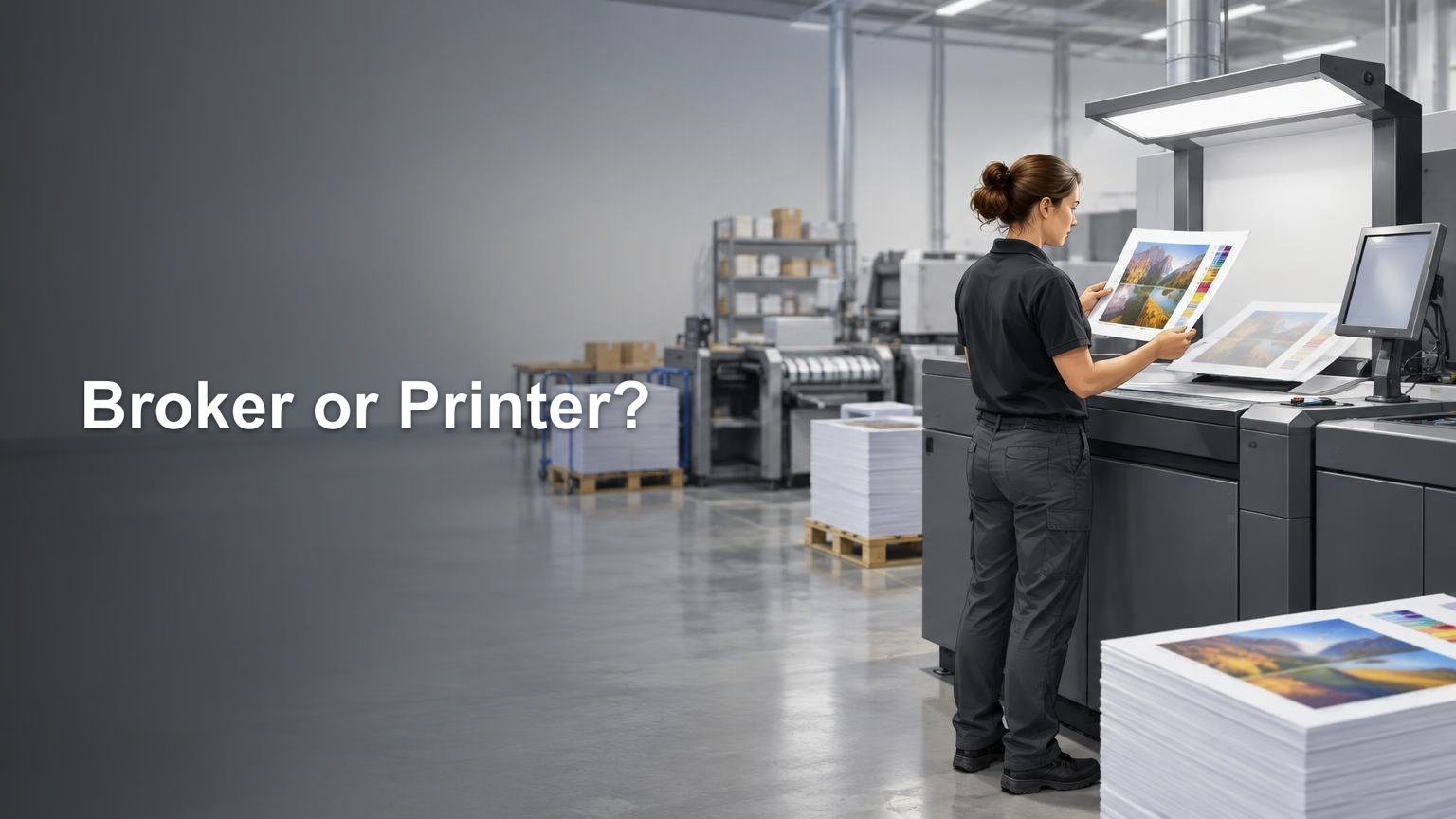
TLDR: The business model matters less than the accountability
A print broker typically manages the order while one or more outside producers manufacture it. A direct printer produces at least some work on its own equipment. A reseller sells print without necessarily producing it, while a trade printer is the wholesale producer behind resellers and other print companies.
None of these models is automatically better. I care about who controls the specification, who approves changes, who produces each component, and who fixes a problem. For ordinary work, one capable point of contact may be enough. For color-critical, finishing-intensive, regulated, confidential, or deadline-sensitive work, knowing the actual producer can materially reduce risk.
Broker, reseller, trade printer, and direct printer are different roles
| Role | What it usually does | What the buyer should verify |
|---|---|---|
| Print broker | Sources production and manages the order, often without operating the production equipment | Which plant produces the work and who has authority to approve changes |
| Reseller or distributor | Owns the customer relationship and resells print or promotional products; it may also produce some items in-house | Which services are internal, which are outsourced, and who handles claims |
| Trade printer | Produces wholesale work for resellers, brokers, agencies, or other printers | Its relevant process, material, finishing, capacity, and quality controls |
| Direct printer | Produces at least part of the job on equipment it operates | Whether every required stage is actually in-house and who manages outsourced components |
The categories overlap. A commercial printer might produce standard brochures internally, send foil stamping to a specialist finisher, and outsource books to a trade plant. A reseller might own digital presses but source labels and large-format graphics elsewhere. Our deeper guide to how trade printers support outsourced production explains why this is normal rather than evidence that something has gone wrong.
PRINTING United Alliance includes distributors among its industry membership types, reflecting that customer-facing print businesses do not all use the same production model. See PRINTING United Alliance’s membership definitions. Equipment ownership tells you where a press sits. It does not, by itself, prove that the seller is good at specifying, scheduling, proofing, or troubleshooting your particular job.
The real issue is who owns the problem
A broker can provide excellent accountability by translating requirements, choosing an appropriate producer, coordinating proofs, managing freight, and taking responsibility for a remake. A direct printer can provide weak accountability if its quote is vague and nobody can explain how the job will be controlled. The reverse can also be true.
The ISO/TC 130 graphic-production guidance separates buyer, prepress, printing, and postpress responsibilities. Printers are expected to control printing-process variability and communicate material visual differences from an agreed reference; postpress operators have corresponding responsibilities for finishing control and defect communication. Read the ISO/TC 130 print-production guidance.
That division matters because a finished product may pass through several businesses. The broker can remain your single contact, but someone still needs authority at every handoff. Before placing a consequential order, I would ask:
- Who performs prepress, printing, finishing, mailing, packing, and fulfillment?
- Who may approve a paper, coating, laminate, quantity, packaging, plant, or schedule substitution?
- Which proof or physical reference defines acceptance?
- Who receives a defect claim, and who decides whether to rework or remake the order?
- Who is responsible for shortages, transit damage, split shipments, and missed delivery dates?
A reassuring answer names the responsible party and the approval path. “We have great partners” may be true, but it is not a production-control plan.
When knowing the actual producer changes the risk
The plant matters most when the job depends on capabilities that are difficult to substitute. Examples include unusual substrates or adhesives, white or specialty inks, tight color or registration requirements, foil, spot effects, complex binding, durable labels, variable data, kitting, mailing, and repeat production at volume. Industry reporting on why print companies outsource specialist work identifies equipment requirements, substrates, finishing complexity, and inefficient volumes as recurring reasons to use trade production.
In those cases, ask about the producer’s relevant workflow rather than requesting a generic equipment list. A press model does not tell you whether the plant regularly runs your substrate, controls the finishing step, has capacity during your delivery window, or can repeat the job six months later.
Knowing the producer also matters when you need confidentiality, traceability, certification, controlled material sourcing, or a fixed location. These requirements should appear in the specification or purchase terms. A casual verbal preference can disappear somewhere between the sales desk and the shipping dock.
For routine business cards, flyers, or standard brochures with ordinary specifications and a generous schedule, the plant identity may matter much less. Accurate files, an appropriate proof, realistic timing, and a vendor who owns the outcome can provide enough control. If you are still assessing suppliers, use a structured process for choosing a print vendor rather than treating “in-house” as a universal quality badge.
A broker is not automatically more expensive
A broker’s margin may pay for specification work, supplier selection, preflight coordination, proof routing, logistics, packaging, fulfillment, and problem management. A direct printer’s attractive unit price may exclude outsourced finishing, freight, mailing, or delivery. There is no useful universal rule that brokers cost more or direct printers always cost less.
Compare the complete job: substrate and grade, flat and finished size, quantity, color configuration, production method where material, finishing, proof type, setup, packing, fulfillment, freight, postage, delivery commitment, quantity tolerance, and remake terms. “Premium stock” is not a specification. It is a mood.
I would also separate price visibility from value. A buyer may reasonably want to know whether a quote contains a management margin, but the more important question is whether the delivered scope is competitive and clearly defined. Saving money by removing coordination is useful only if somebody on your team can perform that coordination.
Proofing must follow the production risk
Proof approval is a shared control point, not clerical permission to press a button. The approved reference might be a soft proof, contract or validation proof, press-sheet sample, prototype, prior-production sample, or finished mock-up. Each predicts different characteristics. ISO guidance notes that many finishing characteristics are not comprehensively represented by general print-process controls, so a color proof cannot promise the feel of a laminate, the strength of a binding, or the behavior of a scored fold.
For a finishing-dependent job, I would ask for a finished prototype or a relevant production sample when practical. For repeat color, identify the approved reference and measurement or tolerance expectations. After delivery, inspect against the specification and proof using a consistent print quality approval checklist.
What I would choose
For general custom printing products and related production topics, Printiverse provides another place to visit the website. For an actual quote, however, insist on a written specification and a named approval path. The logo on the invoice matters less than whether the right producer receives the right instructions—and whether someone accountable is still answering the phone when the cartons arrive.