
TLDR
Paper weight tells you how much paper mass exists for a given area. Caliper tells you how thick the sheet is under a defined measurement method. Two papers can have the same GSM or nominal basis weight and still differ substantially in thickness, stiffness, surface and handling because their density, fibers, coatings and manufacturing differ. If the physical feel or converting performance matters, specify weight and caliper rather than treating one as a substitute for the other.
The short version: mass is not thickness
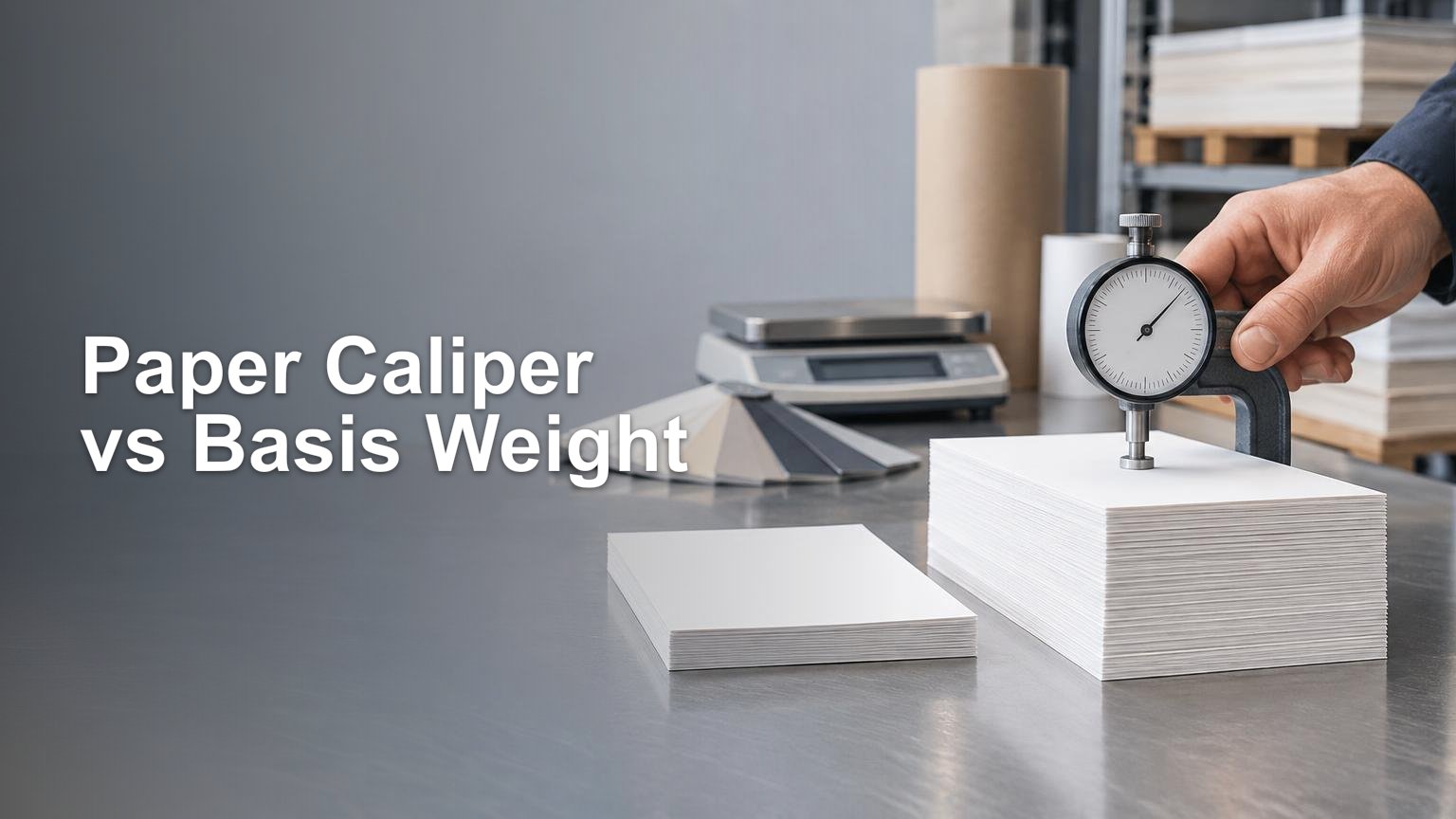
Caliper is the measured thickness of a sheet. In U.S. print specifications, it is commonly expressed in thousandths of an inch, often called mils or points. A 10-point sheet is nominally 0.010 inch thick. Caliper must be measured under controlled conditions because the pressure applied by the measuring instrument can affect the result; the TAPPI/ANSI T 411 caliper method defines that measurement process.
Grammage, normally stated as grams per square metre or GSM, measures mass per unit area. Unlike a North American pound label, GSM uses the same area regardless of whether the product is bond, text, cover or another paper grade. It therefore makes weight comparisons easier, but it still does not specify thickness, stiffness, coating or finish.
| Property | What it measures | Typical expression | What it does not establish |
|---|---|---|---|
| Caliper | Sheet thickness under defined test conditions | Points, mils, inches or micrometres | Mass per area or stiffness |
| GSM or grammage | Mass per unit area | g/m² | Thickness, finish or bending behavior |
| Basis weight | Ream weight at the grade’s designated basic sheet size | Pounds, such as 80 lb text | A directly comparable weight across grades |
| Bulk or apparent density | Relationship between thickness and mass per area | Bulk or g/cm³ | Complete converting performance |
| Stiffness | Resistance to bending under a defined test | Method-specific test result | Weight or thickness by itself |
Why basis weight causes so much confusion
North American basis weight is generally the mass of a 500-sheet ream at the basic parent-sheet size assigned to a paper grade. Those parent-sheet sizes vary. Book paper commonly uses 25 × 38 inches, bond uses 17 × 22 inches, cover uses 20 × 26 inches and newsprint uses 24 × 36 inches.
That means the pound number is incomplete without the grade. An 80 lb text or book sheet is approximately 118 GSM, while 80 lb cover is approximately 216 GSM. Both say “80 lb,” but the cover stock contains much more mass per unit area because its basis-weight calculation starts with a different parent-sheet area.
If you regularly encounter these labels, the companion guide to GSM versus pound paper weight explains the conversion problem in more detail. My practical rule is simpler: never compare two pound values until you know the paper category behind each one.
Why equal-weight papers can have different calipers
Bulk and apparent density connect weight to thickness. At a given GSM, a bulkier, lower-density sheet is thicker. A denser sheet packs the same mass into less thickness. Apparent density in g/cm³ can be calculated by dividing grammage by caliper in micrometres; bulk is the reciprocal of density.
Fiber furnish, refining, fillers, coatings, compaction, calendering and moisture can all change the sheet’s structure and feel. Calendering, for example, can produce a smoother, more compact sheet. A paper engineered for higher bulk can feel more substantial without adding the same amount of mass that a denser sheet would require.
This is why “premium 100 lb paper” is not a complete specification. Premium is an opinion, and 100 lb is ambiguous without the grade. I would ask for the grade, GSM, caliper, finish and exact mill sheet where available. A physical sample is even better when feel is part of the buying decision.
Thickness is not the same as stiffness
A thicker sheet often feels more substantial, but caliper alone does not guarantee a proportional increase in stiffness. Stiffness is resistance to bending, and TAPPI uses a separate test method for it. The organization also distinguishes a test result such as bending resistance or moment from bending stiffness as a material property independent of specimen dimensions and test setup. TAPPI’s paper and paperboard bending-resistance method documents that distinction.
Fiber orientation, bonding, density, coating, moisture, grain direction and the dimensions of the finished piece can all affect bending behavior. A narrow card, a large menu and a folded carton panel made from the same material will not behave as though stiffness were one universal number. Folds and scores alter the result again.
If rigidity matters, describe the application rather than asking only for a “thick stock.” Tell the printer whether the piece must stand upright, feed through equipment, resist sagging, fold cleanly or survive repeated handling. The functional requirement is more useful than an adjective.
Where caliper changes the finished job
Caliper can affect the physical build of a product even when GSM stays constant. A bulkier text sheet produces a thicker book block. A thicker board produces a thicker carton blank. Those changes can matter to binding, scoring, folding, packing and the dimensions of the finished item.
Fold and score performance should also be treated as separate requirements. Nominal weight and caliper do not automatically tell you whether a sheet will fold attractively or whether a score will perform properly; TAPPI maintains distinct methods addressing score bend and score quality.
This distinction applies across custom printing and print-production work. Before approving a substitute stock, check whether the new sheet changes the thickness of the assembled piece, the grain direction, the folding or scoring plan, or the equipment through which it must pass. A substitution that matches GSM but not caliper may still change production.
Postal rules may care about both weight and thickness
Postal compliance is a particularly good reason to stop using “it feels heavy enough” as a specification. USPS commercial-mail standards use defined basis-weight equivalents. Standard sealed envelopes and letter-size pieces sealed on all four sides require at least 50 lb book paper or an equivalent paper weight.
For folded self-mailers, USPS generally requires at least 70 lb book weight or equivalent for pieces up to one ounce and 80 lb for pieces over one ounce. Some designs involving die cuts or perforated panes require heavier paper, and sealing requirements also apply. The current details belong in the USPS commercial mail design standards, not in someone’s memory of the last mailing.
Meeting a paper-weight minimum does not guarantee that the completed mailpiece qualifies. USPS also specifies physical and machinability criteria. Letter-size booklets, for example, have cover-weight requirements and a permitted thickness range of 0.009 to 0.25 inch. Publication 25 sets a maximum letter thickness of one-quarter inch and evaluates the complete piece, including folds, inserts, closures and uneven components.
For a serious mailing, I would have the finished construction reviewed—not merely the flat sheet. An insert, adhesive tab or fold can change the mailpiece that postal equipment actually encounters.
What to put in a paper specification
A useful paper specification identifies the properties that control the actual job. Depending on the application, include:
- Paper grade and product name
- GSM, or basis weight with the paper category clearly identified
- Target or published caliper
- Coated or uncoated surface and the specific finish
- Grain direction when folding, binding or dimensional behavior matters
- Required stiffness or bending performance when rigidity matters
- Folding, scoring or creasing requirements
- Acceptable equivalent stocks and which properties must match
- A physical sample or production proof when feel and handling drive approval
These properties do not all need to appear on every simple print order. They do need to appear when a mismatch could affect fit, postage, folding, binding, feeding or customer perception. A cheap quote becomes less cheap when the “equivalent” stock builds a different product.
How I would compare two papers
First, normalize the weight using GSM or a correctly identified basis-weight system. Second, compare caliper. Third, look at finish, coating, grain and the stiffness or converting requirement relevant to the product. Finally, examine a representative sample in the finished size rather than judging only a full sheet.
The decision rule is straightforward: use weight to compare mass, caliper to compare thickness and a functional specification to compare performance. When a paper choice matters enough to debate, it usually matters enough to name more than one number.
References
- Thickness (caliper of paper, paperboard, and combined board, Test Method TAPPI/ANSI T 411 om-21
- Grammage of paper and paperboard (weight per unit area), Test Method TAPPI/ANSI T 410 om-23
- DMM 201 Physical Standards for Commercial Letters, Flats, and Parcels
- Physical and Optical Properties, Part 1
- Basis Weight, Caliper, Density
- Common Physical Tests for Paper and Board
- Bending resistance (stiffness) of paper and paperboard, TAPPI/ANSI T489 om-22 – T 489 om-22
- Secrets of a Level Process and Product, 2001 Engineering / Finishing & Converting Conference Proceed
- Standards Advisory Review Group
- 200 Commercial Letters, Flats, and Parcels Design Standards | Postal Explorer
- pub25.book