
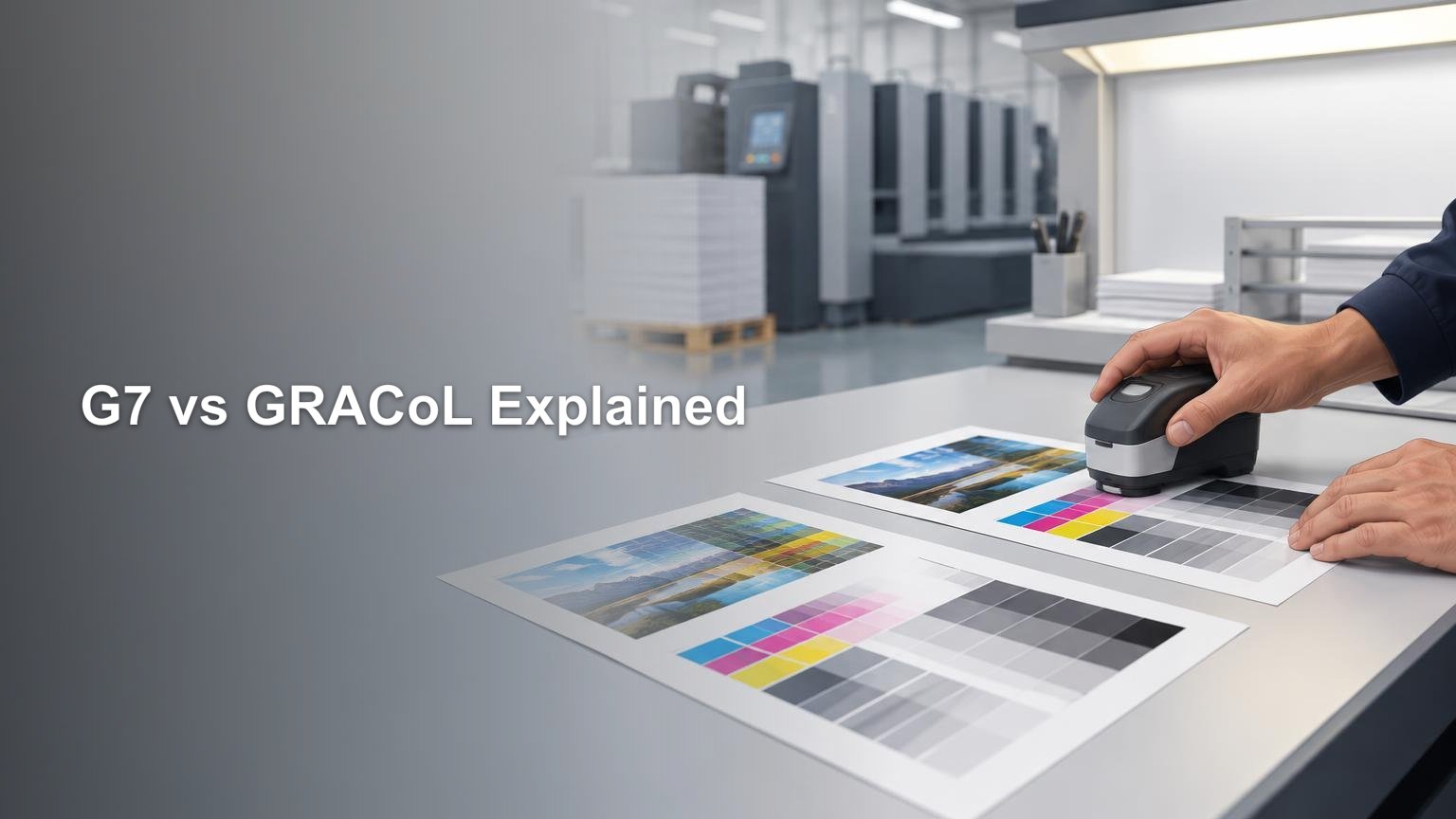
TLDR: G7 or G7+ is a calibration approach used to produce predictable tonality, gray balance and near-neutral appearance. GRACoL is a family of commercial-print specifications and reference print conditions supported by characterization data, profiles and control resources. They are complementary, not competing choices. A printer can calibrate with G7 methodology while targeting a GRACoL condition.
The practical G7 vs GRACoL question is therefore not “Which one is better?” It is “What condition is this job meant to match, and has the actual production workflow been calibrated, characterized and controlled for it?” A certificate on the wall is useful. It is not a job specification.
G7 vs GRACoL in one sentence
| Term | What it does | What it does not prove |
|---|---|---|
| G7 or G7+ | Provides a methodology for calibrating print toward defined neutral appearance and tonality behavior | That every device, substrate or job matches GRACoL |
| GRACoL | Describes commercial-print reference conditions and supplies related characterization data, profiles and control tools | That a particular press is currently stable or that every stock will reproduce the condition |
| G7 Master Facility Certification | Shows that submitted devices met stated requirements and compliance levels within the certification scope | That every device or job at the facility is covered indefinitely |
PRINTING United Alliance describes G7 as a calibration method for visual consistency and associates GRACoL with commercial sheetfed offset print conditions. Its overview of print production specifications is a useful starting point for understanding these different roles.
What G7 and G7+ mean in production
G7 is often called a “color standard” in everyday print conversations. That shorthand is understandable but incomplete. It is more useful to think of G7 as a calibration methodology: it helps bring a printing system toward specified tonality and gray-balance behavior. It does not, by itself, name every colorimetric characteristic of the final printing condition.
Current PRINTING United Alliance materials use G7+ terminology for system and expert certification while framing the approach around CMYK near-neutral and gray-balance calibration. Buyers may still encounter established G7 and G7 Master language, so I would ask which methodology or version was used rather than trying to infer it from the logo.
Calibration is also only one part of color management. Characterization records how a printing condition behaves, profiling translates between color spaces, proofing predicts the intended result, and production control checks whether output remains within the agreed limits. These are related jobs, not interchangeable words. The broader workflow is explained in this guide to print process control.
What GRACoL actually specifies
GRACoL provides specifications and resources for commercial printing. When someone says a job is “GRACoL,” however, that statement still needs unpacking. They might mean the broader GRACoL specification family, a particular characterization dataset, an ICC profile derived from that data, or the GRACoL 2013 reference condition associated with CRPC6. Those meanings are connected, but they are not identical.
A reference print condition describes a defined printing result. Characterization data records the relationship between CMYK input values and measured color for that condition. An ICC profile can then be built from the dataset for color conversion and separation. The ICC registry notes that more than one profile can be made from the same characterization data because profile-building and separation choices can differ.
That distinction matters when files are converted. “We used a GRACoL profile” is more informative than no answer, but I would still want the profile name, the intended output condition and confirmation that the proof and production workflow are aligned. A profile is not a tiny digital foreman who keeps the press under control.
How G7 and GRACoL work together
A printer can use G7 or G7+ methodology to calibrate a press or proofing system and then aim that system at a GRACoL reference condition. It can also use the calibration methodology with another established reference condition or a custom characterization suited to a different process and substrate.
This is why the categories should not be treated as rivals. G7 helps answer how the system is calibrated for neutral appearance and tonality. GRACoL helps answer what commercial-print condition the workflow is intended to represent. Ongoing measurement then answers whether production continues to hit the agreed target.
For buyers still selecting a production route, broad commercial printing options can help frame the available processes, but the color requirement still has to be attached to a specific device, material and approval method.
Why certification does not settle the job specification
G7 Master Facility Certification is meaningful evidence of an evaluated capability, but its scope matters. PRINTING United Alliance ties certification to submitted devices and stated compliance levels, and lists it as valid for one year. It does not automatically establish that every press, proofing system, stock, location or specialty workflow is qualified for your job.
If matching a supplied GRACoL proof is contractually important, ask whether the quoted production device and proofing workflow are included in the relevant scope. Also define the tolerance and approval procedure. “G7 facility” and “must match this approved proof under agreed viewing conditions” are not equivalent purchasing instructions.
When GRACoL may not be the right target
GRACoL can be highly useful for appropriate commercial-print work, but no reference condition should be applied by habit. The selected condition needs to fit the process, substrate and intended appearance.
For example, the ANSI listing for the GRACoL technical report identifies characterization data for proofing and printing on U.S. Grade 1 coated paper. It also calls attention to specified measurement conditions and considerations involving optical brightening agents, or OBAs. These fluorescent additives can affect measured and viewed paper white depending on illumination and measurement settings.
A materially different uncoated sheet, UV workflow, synthetic substrate, expanded-gamut ink set or heavily finished piece may need another established condition or a custom target. PRINTING United Alliance publishes separate resources for workflows including uncoated UV and expanded gamut, which illustrates why one profile should not be treated as universal.
Finishing matters too. A laminate, coating or textured surface can change gloss, contrast and perceived color after the press sheet was measured. If the finished object is what the customer approves, the approval plan should account for the finished object.
What to ask your printer before approving color
- What exact reference print condition are you targeting? Ask for its proper name, not just “GRACoL.”
- Which production device, ink or toner system and substrate will be used for my job?
- Is that device covered by the facility’s current certification or qualification scope?
- Which ICC profile and characterization dataset are being used, and where in the workflow is conversion performed?
- What proof will I receive: a calibrated contract proof, a press proof, a content proof or an uncalibrated visual sample?
- Will the proof simulate the production paper white, including relevant OBA behavior?
- What viewing illumination, measurement condition and tolerance will govern approval?
- How are spot colors, brand colors, white ink or expanded-gamut separations handled? For process versus spot-color decisions, see Pantone vs CMYK printing.
- Will coating, lamination or another finish materially change the approved appearance?
- What happens if production falls outside the agreed tolerance?
I would put the important answers in the purchase specification or proof approval record. If two printers are quoting different stocks, proof types or acceptance criteria, they are not quoting the same color-control package. Compare the complete specification before choosing a vendor; the lowest price becomes much less interesting when the approval target is vague.
Specify the result, not just the label
The useful conclusion to G7 vs GRACoL is that buyers often need both concepts. G7 or G7+ can support disciplined calibration. GRACoL can provide an appropriate reference condition for suitable commercial-print work. Neither removes the need to define the actual device, stock, profile, proof, viewing conditions, tolerances and finishing effects.
For a color-critical job, ask the printer to connect every claim to your production path: this device, this material, this target, this proof and this acceptance rule. That is what turns a certification or profile name into a controlled result rather than a reassuring collection of capital letters.
References
- Print Properties Committee (PPC) | PRINTING United Alliance
- G7+ Expert Certification | PRINTING United Alliance
- G7+ System Certification | PRINTING United Alliance
- GRACoL® | PRINTING United Alliance
- CMYK Characterization Data
- G7 Master Facility Certification| PRINTING United Alliance
- CGATS/GRACoL TR 006-2016 (R2023) – Graphic technology – Color characterization data for GRACoL® proofing and printing on U.S. Grade 1 coated paper
- www.printing.org