
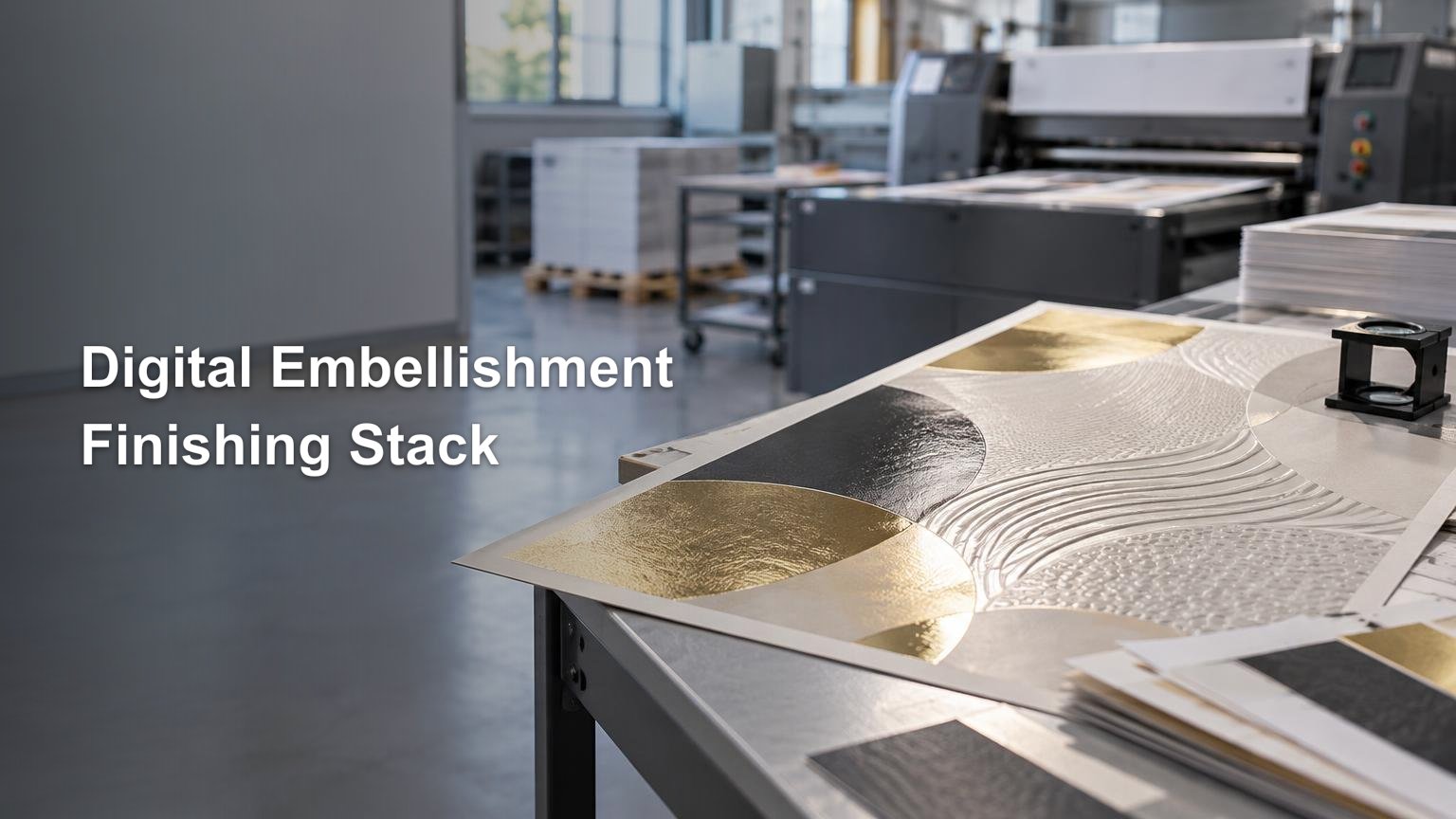
TLDR
Digital embellishment printing adds decorative elements such as foil, spot gloss and raised texture using digitally imaged toner, varnish or polymer. It can eliminate metal dies, support short runs and allow the decorated element to vary from sheet to sheet. It does not make conventional foil stamping, embossing or screen coating obsolete. The best process depends on the required relief, substrate, coverage, registration, quantity and number of artwork versions.
My practical rule is simple: specify the physical result before asking for “digital embellishment.” That term covers several different production methods. A flat toner foil, a raised polymer foil and a mechanically embossed hot-foil mark may all look metallic in a photograph, but they do not feel, register or cost the same.
Digital embellishment is a family, not a single process
The FSEA foil reference for designers distinguishes conventional hot and cold foil from digital approaches. Within digital production, the two broad families are toner-receptive foil and inkjet-applied varnish or polymer systems. Their image carriers, setup requirements, textures and suitable run lengths differ.
| Method | How the effect is formed | Typical character |
|---|---|---|
| Toner-based digital foil | A toner image receives foil under heat and pressure | Usually a relatively flat metallic image |
| Inkjet varnish or polymer | Clear material is deposited and cured selectively | Spot gloss or tactile texture, with build controlled by deposited material |
| Polymer-based digital foil | Foil transfers to a digitally applied receptive layer | Metallic decoration that may be raised |
| Conventional hot foil and embossing | Machined dies apply heat, pressure or physical deformation | Strong foil definition and true paper deformation |
Toner foil is attractive when a job needs a digitally defined metallic image without a foil-stamping die. Polymer or varnish systems can deposit clear material for selective gloss and texture, or create a foil-receptive layer. Building multiple layers can produce raised varnish and raised foil.
The phrase “digital embossing” needs particular care. It commonly describes raised varnish or raised foil, not mechanical embossing with a die and counterdie. The digital effect sits on the surface; conventional embossing physically reshapes the sheet and can create deeper or sculptured relief. Similar from across the room is not the same production specification.
Variable embellishment changes the value proposition
Some systems can vary the embellishment itself from piece to piece. A foil name, textured pattern or spot-gloss element can change along with the printed image, without requiring a separate physical die for every version.
That capability matters for personalized covers, numbered collectibles, segmented direct mail and short batches of packaging. The business case is not merely “foil without a die.” It is foil or texture that can become part of the variable-data workflow. Conventional tooling remains perfectly sensible when every copy is identical and the quantity is high.
Registration is where the brochure meets production
Embellishment usually has to land on an image printed earlier. Sheet-oriented systems may scan each sheet and correct rotation, scale and position before applying the effect. Scodix, for example, describes individual-sheet correction and publishes a system-specific ±100-micron image-to-image registration specification for its Ultra2. That number describes one configured system; it is not a universal promise for digital embellishment.
More importantly, an equipment registration specification is not permission to design hairline foil borders around tiny type. Fine knockouts, tight outlines, folds, trims and die cuts introduce their own tolerances. I would ask the printer for minimum line, gap and trap recommendations for the exact press, stock and effect. If the decoration must align critically with color, approve a representative embellished proof rather than relying only on a PDF.
The same discipline applies when the base print contains spot colors or a demanding brand match. Decide whether the embellishment is hiding, framing or exposing registration variation, then coordinate it with the underlying color specification. The distinction between process simulation and a true spot ink is covered in this guide to Pantone and CMYK printing.
Substrate compatibility is not a checkbox
A machine’s broad media list does not mean every stock will produce the same adhesion, gloss or foil release. Surface chemistry, roughness, absorption, coating, lamination, static, storage conditions, curing and foil choice can all affect the result. Suppliers consequently recommend suitability and adhesion testing for foil and plastic applications.
Raised liquid-polymer effects often perform best over a compatible varnish or lamination layer. Thick, textured uncoated papers can be more difficult because the deposited material must contend with an irregular, absorbent surface. Conventional foil stamping may be the better choice for some of these stocks.
This is also why I would not approve an embellishment quote that says only “premium stock.” That is a mood, not a substrate specification. Identify the manufacturer and grade where possible, plus weight or caliper, surface treatment, base print process, laminate or coating, and any later scoring, folding or cutting. For wider coverage of custom printing and production options, see printiverse.com.
Run economics depend on more than eliminating the die
Digital production removes metal dies and much of their associated preparation, which can make short runs, frequent revisions and variable work commercially practical. It still requires file setup, masking, material qualification, registration control, curing, inspection and spoilage allowance. Some designs also require multiple passes.
Coverage is a major cost and throughput variable. A small logo with selective gloss is not equivalent to flooding most of a sheet with thick varnish. Build height, foil area, sheet size, passes, substrate preparation, curing and inspection all affect the route. Canon’s documentation for one varnish-capable inkjet platform specifically notes that large varnish areas reduce productivity and recommends concentrating varnish in spot-decoration areas.
There is therefore no honest universal crossover quantity. Compare the tooling and makeready of the conventional route with the digital process cost per sheet, then include versions, spoilage, finishing, inspection and schedule risk. This is the same reason digital-versus-offset cost comparisons cannot be reduced to one magic run length.
Where conventional finishing still wins
Conventional finishing remains strong for long, static runs; true sculptured or multi-level embossing; difficult stocks; and applications already optimized around high-speed foil, coating or converting equipment. The WhatTheyThink discussion of traditional finishing technology notes that screen UV can be more economical at larger quantities because screen equipment may operate considerably faster than offline digital coating equipment.
Screen processes can also deliver gloss, matte, satin, glitter, soft-touch and pearlized coatings, depending on the equipment and chemistry. Conventional and inline foil systems remain appropriate for high-volume labels, cartons, cards and covers. The digital device may have no tooling delay, but the faster production line does not become embarrassed and leave the building.
What I would put on the specification
- Define the effect as flat foil, raised foil, spot gloss, raised clear texture or true mechanical embossing.
- Name the substrate, weight or caliper, surface treatment and base printing process.
- Provide separate artwork masks and ask for minimum line, gap, trap and build recommendations.
- State whether the embellishment is static or variable and how many versions are required.
- Specify critical alignment points, then account separately for folding, trimming and die-cut tolerances.
- Request a production-representative embellished proof when appearance, adhesion or registration is critical.
- Compare total delivered cost, including setup, spoilage, extra passes, inspection, finishing and freight.
Digital embellishment is most valuable when it removes disproportionate setup, enables useful variation or creates a tactile effect at a quantity conventional tooling handles awkwardly. Conventional finishing wins when its speed, material behavior or physical deformation better fits the job. Start with the desired object, not the machine category, and the finishing stack becomes much easier to specify.
References
- FSEA and PaperSpecs Release Print Decorating Reference for Designers: Foil Cheat Sheet – FSEA
- Digital Foils – FSEA
- Digital Decorating: Finding the Sweet Spot » PostPress
- Industrial Printers | Commercial Printing | KONICA MINOLTA
- Client Engagement Center | KONICA MINOLTA
- Digital Embellishment Technology | Scodix
- Add A Secret Ingredient to Your Print Shop – Scodix
- Scodix Ultra2 Digital Enhancement Presses
- PowerPoint Presentation
- Printing News
- Arizona 1300 GTF / XTF Series
- APPEARANCE MANAGEMENT TECHNOLOGY OUTLOOK—Traditional Finishing/Embellishment Technology Is Still Relevant – WhatTheyThink