
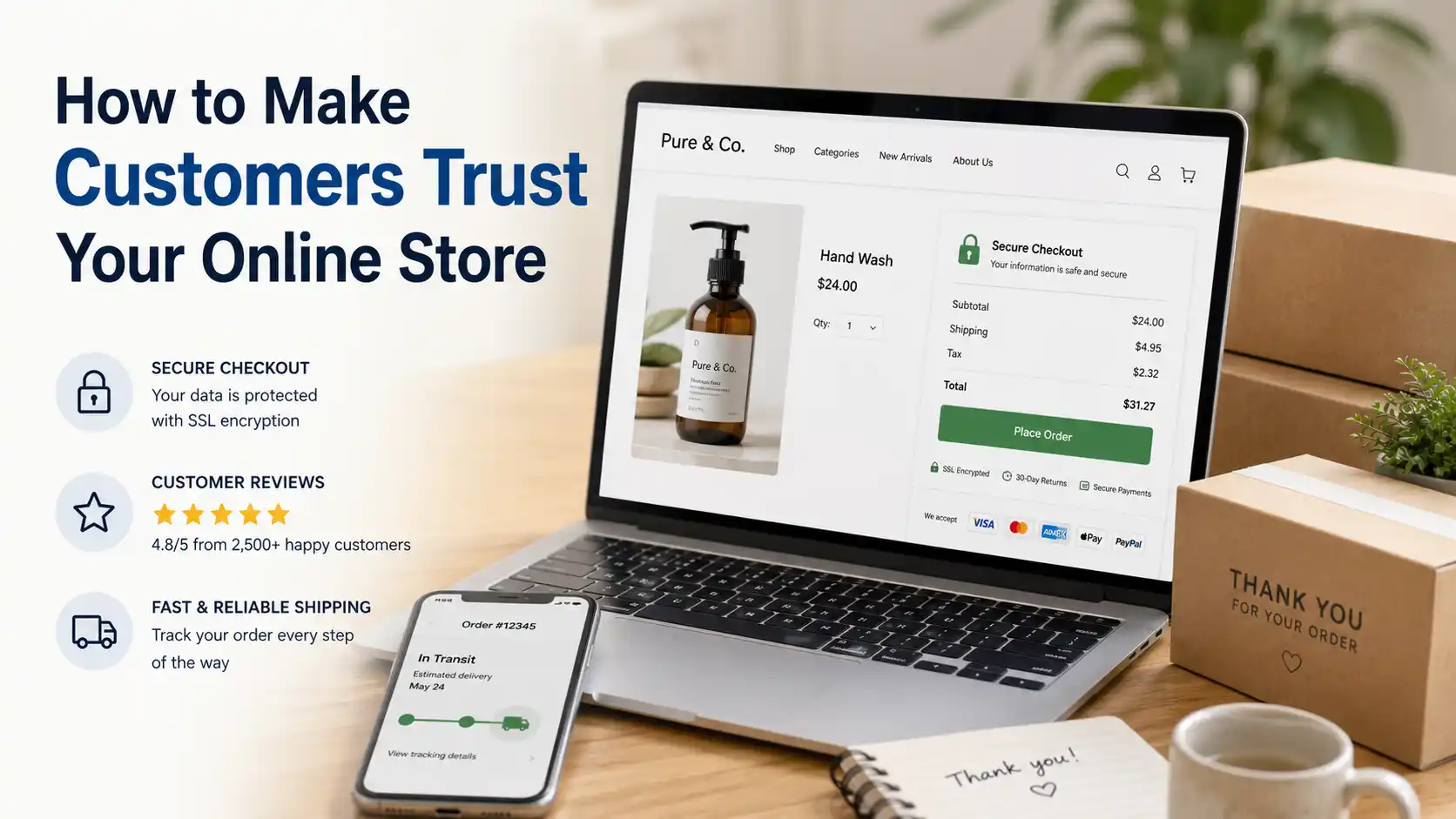
TLDR
Customers trust an online store when the business feels clear, real, and safe to buy from.
The fastest trust signals are simple: honest product pages, visible contact information, clear shipping and return policies, real reviews, secure checkout, and no surprise fees.
A small store does not need to look huge. It needs to look organized, responsive, and honest.
The best trust improvements usually happen before checkout, not after the cart is already abandoned.
The first sale from a new customer is a small act of faith. They are sending money to a business they may have found through search, social media, an ad, or a recommendation from someone they barely know. That is a lot to ask from one product page.
So if you are wondering how to make customers trust your online store, start by looking at the page the way a cautious buyer would. Is the business easy to understand? Is the product clear? Can the customer tell what happens after they order? Is there a real way to get help? If the answer is fuzzy, the customer may leave without saying a word.
That is the frustrating part. People rarely email you to say, “I almost bought, but your return policy was hard to find.” They just disappear.
Why Online Store Trust Matters So Much
A physical shop gets trust signals for free. Customers can see the door, the staff, the shelves, the register, and the product in front of them. An online store has to create that same confidence through words, images, layout, policies, reviews, checkout design, and follow-through.
That does not mean every small brand needs a giant corporate website. In fact, trying to look bigger than you are can backfire. Customers are usually fine buying from a small business when the store feels real and the details make sense.
Trust breaks when something feels unfinished, hidden, or too clever.
A customer might hesitate if:
- the product photos look inconsistent
- the descriptions are thin
- shipping costs appear too late
- the return policy is vague
- there is no contact information
- reviews feel fake or missing
- checkout asks for too much information
- the site uses aggressive popups or countdowns
- the brand story sounds generic
None of those issues has to mean the store is bad. But online shoppers are trained to be careful. They have seen polished stores that overpromise, ship late, or disappear when something goes wrong.
The goal is not to pressure customers into trusting you. The goal is to remove reasonable doubt.
How to Make Customers Trust Your Online Store With Better Product Pages
Product pages do most of the heavy lifting. They are where interest turns into a decision.
A good product page should answer the customer’s quiet questions before those questions become objections. What is this? Who is it for? What size is it? What material is it made from? What does it include? How will it arrive? What happens if it is not right?
This is especially important for products where the customer cannot touch, try, smell, measure, or inspect the item before buying. Apparel, skincare, printed goods, home products, food items, collectibles, handmade products, and custom products all need extra clarity.
Strong product pages usually include:
- clear product photos from several angles
- close-up images of texture, finish, size, or important details
- plain product descriptions
- dimensions, materials, ingredients, or specs
- care instructions when relevant
- what is included and what is not included
- realistic shipping expectations
- return or exchange notes near the buying decision
- customer reviews or examples when available
The trick is to be specific without writing a novel.
For example, “high quality fabric” does not say much. “Midweight cotton with a soft matte feel” gives the customer something useful. “Fast shipping” is vague. “Most orders ship in 2 to 4 business days” is clearer, assuming that is accurate for the business.
Do not hide limits. If an item is final sale, say that plainly. If handmade items have small variations, explain that before checkout. If custom products cannot be returned unless there is a production issue, make that visible before the customer pays.
A little honesty early prevents a lot of frustration later.
Make the Business Feel Real
Customers often scan a new online store for signs that real people are behind it. This is not complicated, but it is easy to overlook.
At minimum, a trustworthy store should have a clear About page, contact page, policy links, and support information. The About page does not need a dramatic founder story. It just needs to explain what the business sells, who it serves, and why the store exists.
A good About page can be simple:
“We make small-batch candles for people who want clean scents, clear ingredients, and packaging that feels giftable without being fussy.”
That tells the customer more than a vague paragraph about passion and excellence.
Contact information matters too. A contact form is fine, but it should not be the only sign of support. Add a support email, expected response time, and links to shipping, returns, and order questions. If you offer chat, make sure someone actually checks it. A dead chat widget is worse than no chat widget.
For small brands, a real support promise often works better than a big-brand imitation.
Try wording like:
“Questions about sizing or your order? Email us at support@example.com. We usually respond within one business day.”
That one sentence does a lot. It tells the customer there is a path if something goes wrong.
Show Policies Before Customers Need Them
Shipping, returns, refunds, privacy, and warranty information should be easy to find. Not buried. Not written like a legal trap. Not hidden behind a footer link in tiny gray text.
Customers look for policies because they are measuring risk.
A clear shipping policy should explain:
- where you ship
- how long processing usually takes
- available shipping methods
- when tracking is sent
- what happens with lost or delayed packages
- how international orders, duties, or taxes are handled if relevant
A clear return policy should explain:
- return window
- eligible and ineligible items
- item condition requirements
- who pays return shipping
- refund timing
- exchange options
- how to start a return
This is one of those small details people forget until it suddenly matters.
If your policy is strict, clarity matters even more. A strict but clear policy is often better than a friendly-sounding policy that leaves customers guessing. People can accept limits. They are less patient with surprises.
Use Reviews and Social Proof Without Making Them Feel Fake
Customer reviews help because they shift the trust question from “What does this brand say?” to “What did buyers experience?”
But reviews only work when they feel real.
A page full of vague five-star comments can feel less trustworthy than a smaller set of detailed reviews. “Love it” is nice. “The medium fit my 5’8 frame well, and the color looked like the third photo” is useful.
If your store is new and does not have many reviews yet, do not fake it. Start with other trust signals:
- product photos from real customers, with permission
- testimonials from early buyers
- before-and-after examples when relevant
- press mentions, marketplace ratings, or creator feedback
- user-generated content from social platforms
- clear product guarantees, if the business can support them
A new store can also add a short note near reviews:
“We are still collecting product reviews. Have a question before ordering? Send us a note and we will help.”
That is not as strong as 300 reviews, but it is honest. Honest beats artificial.
Keep Checkout Calm and Transparent
Checkout is not the place to get clever.
By the time a customer reaches checkout, your job is to reduce friction. Show the total cost early. Let people use guest checkout when possible. Avoid surprise shipping fees, forced account creation, confusing discount fields, or last-second add-ons that feel sneaky.
A trustworthy checkout should answer these questions quickly:
- What is my total?
- What shipping options do I have?
- When will this arrive?
- Is payment secure?
- Can I check out without creating an account?
- Can I review my order before paying?
- Who do I contact if there is a problem?
Trust badges can help, but they are not magic. A secure checkout badge next to a messy, confusing checkout will not fix the real problem. The best trust signal is a checkout flow that behaves the way customers expect.
Also, be careful with urgency tactics. Real scarcity is fine. Fake urgency trains customers not to believe you. If there are only four handmade items left, say that. If the timer resets every time someone refreshes the page, stop doing that.
Short-term pressure can create sales. It can also create refunds, support tickets, and a brand people do not want to revisit.
Avoid Design Choices That Feel Manipulative
Some ecommerce tactics technically “work” because they push people into action. That does not mean they build trust.
Avoid patterns like:
- hiding fees until the final step
- making cancellation or returns hard to find
- pre-checking unwanted add-ons
- using fake stock warnings
- disguising ads as neutral recommendations
- making the “no thanks” option sound insulting
- forcing customers through too many popups before they can shop
A small store has an advantage here. You can be more direct. You do not need five layers of persuasion machinery to sell a good product. You need clear information, a fair offer, and a buying path that does not make customers feel trapped.
In most cases, clean beats clever.
Build Trust After the Order Too
Pre-purchase trust gets the first order. Post-purchase trust earns the second one.
After a customer buys, they should know what happens next. Send a clear confirmation email. Send tracking when the order ships. Explain delays before the customer has to ask. Make the package feel intentional when it arrives.
This is where physical brand touchpoints can help. A simple printed card, care guide, product insert, or thoughtful thank-you note can make an online business feel more concrete. KitYarrow has already covered that idea in more depth in How Physical Print Products Can Make an Online Store Feel More Real and Packaging Inserts for Ecommerce: What to Include and What to Skip.
The important thing is to keep the post-purchase experience useful. Do not bury customers in five emails asking for a review before the package even arrives. Give them the product, help them use it, then ask at the right time.
A good post-purchase flow might look like this:
Order confirmation right away.
Shipping update when tracking is ready.
Delivery or care email after the package arrives.
Review request after the customer has had time to use the product.
That feels normal. Normal is underrated.
A Simple Online Store Trust Checklist
Here is a practical way to audit your own store.
Open your homepage, a product page, cart, checkout, About page, contact page, shipping policy, and return policy. Then ask:
- Can a new customer tell what we sell in five seconds?
- Do product pages answer the most common buying questions?
- Are product photos clear, consistent, and realistic?
- Is shipping information visible before checkout?
- Is the return policy easy to understand?
- Is there a real support email or contact path?
- Do reviews, testimonials, or examples feel authentic?
- Does checkout show costs clearly?
- Are customers allowed to check out without unnecessary friction?
- Are any popups, countdowns, or add-ons making the store feel pushy?
- Does the confirmation email explain what happens next?
- Would I buy from this store if I had never heard of it?
That last question matters. Be honest. Store owners get used to their own sites and stop seeing the small doubts that new customers see immediately.
Common Mistakes That Hurt Online Store Trust
One common mistake is overdesigning the store while under-explaining the product. A polished layout is nice, but customers still need the basics. Size, material, shipping, returns, and support beat mood every time.
Another mistake is copying large ecommerce brands too closely. A small store does not need to pretend it is a department store. It needs to be clear, focused, and reliable.
A third mistake is treating policies like fine print instead of customer experience. Shipping and returns are not just legal pages. They are part of the buying decision.
The last mistake is using too many conversion tactics at once. Popups, countdowns, spin wheels, sticky bars, review widgets, bundles, upsells, and chat prompts can pile up fast. Each one may seem harmless alone. Together, they can make the store feel noisy.
Remove anything that does not help the customer make a confident decision.
Final Thoughts
Learning how to make customers trust your online store is mostly about reducing uncertainty. Clear product pages reduce product risk. Visible policies reduce purchase risk. Real reviews reduce social risk. Secure, simple checkout reduces payment risk. Good support reduces the fear of being ignored.
None of this requires a massive redesign.
Start with the basics. Make the business easy to understand. Make the product easy to evaluate. Make the policies easy to find. Make checkout feel safe. Then follow through after the order.
That is how trust usually gets built: not through one dramatic promise, but through a series of small details that all say the same thing.
This store is real.
This order will be handled properly.
And if something goes wrong, someone will help.
FAQs
What is the fastest way to make an online store look more trustworthy?
The fastest improvement is usually clearer information. Add visible contact details, shipping timelines, return policy links, product specs, and real support wording. Customers do not need every detail on one page, but they need to know the answers exist.
Do trust badges actually help ecommerce stores?
Trust badges can help near payment points, but they work best when the rest of the checkout experience is already clear. A badge will not fix hidden fees, confusing shipping, missing policies, or a checkout flow that feels unsafe.
How can a new online store build trust without reviews?
Use clear product pages, honest photos, a strong About page, visible support information, transparent policies, and early testimonials when available. Do not fake reviews. A small number of real trust signals is better than a page full of suspicious praise.
Should small online stores offer free returns?
Free returns can lower purchase risk, but they are not realistic for every store. If free returns would hurt the business, use a clear return policy instead. Customers mainly need to know the rules before they buy.
What makes customers abandon checkout?
Customers often abandon checkout when costs are too high or unclear, delivery feels too slow, the checkout process is too long, the site feels unsafe, or the return policy is not satisfactory. Many of those issues can be improved with clearer information earlier in the buying path.business ecommerce